I saw the signs… and it opened up my eyes

Since being diagnosed with anxiety and depression, I have become aware of the symptoms… at least I thought I was. I’m very much still on my healing journey, and sometimes, need someone outside of myself to tell me that my “check engine” light is on. 

Things were happening in my life, that irritated me, and made me sad, and annoyed. But I thought that it was just that. A normal reaction to life sucking. A side effect of adulting. 

Until my psychologist told me to make a call to my psychiatrist. And it switched on a light for me, highlighting to me that my “check engine” light was on… and flashing aggressively. And I was ignoring it, and continuing to drive far into the distance without stopping. My psychologist had to point it out to me that I am not ok. 

And then I started looking around. I was exercising, sure, but begrudgingly, and where I could cancel, I did. My eating was well, indulgent, to say the least. I was not reading (beep! beep! beep!), I was not writing. And worst of all, I spent all of my time at work complaining, not laughing (I mean, working) at work. I didn’t see it. I was depressed. More depressed than I had been in a very long time. 

When I finally saw the signs, I could do something about it. 

Thankfully, it coincided with a meditation course I was on. Meditation is one of those things that can really help. I didn’t realise how much, but once I became aware of my feelings, I could become aware of what they were doing in my body. And that is why mindfulness is so helpful for mental health, and how meditation can help to relieve some of those difficult emotions. 

Once I realised I had been mindlessly eating, I made a concerted effort to be mindful about my eating. I don’t always make the right choices, but at the very least I am making conscious choices. And that is important for me. Because you can only change something that you are aware of. 

I also had to watch uplifting content, and for a while I refused to allow myself to watch anything but comedies, but then I realised that my crime series was strangely uplifting because there was a resolution, and I enjoyed the problem-solving. Sometimes what is uplifting is strangely un-uplifting from the outside, but nevertheless, it’s whatever makes you happy. 

I made sure that I switched off all devices an hour before bedtime, to ensure I got a good night’s rest, which opened up an entire extra hour in my day for me to read. Which, in a virtuous circle, helped me to fall asleep faster too. (also, I put down the sad stories about people going through what I’m going through, and read inspiring stories, self-help books, and books about finding meaning). 

I also allowed myself to lean on others, and let them help and support me (a biggie). I didn’t have to do this all on my own. There was no shame in how I was feeling, and I had friends and family who were willing to listen to me and be there for me, whenever. (thanks, by the way)

And then there was writing – this blog, in fact. I spent some time researching the concept of self-worth, and it was a turning point for me. It made me realise that I was putting my worth into the wrong things, and giving away my power to issues and people who really didn’t deserve the power of the mind I was giving them. I have a lot to learn about self-worth, and a long way to go before I truly realise my self-worth, but the car is in the shop, while I continue on this journey (ok, this analogy isn’t really working out, but you get the idea). 

It’s never to late to begin again

Sometime in last year, I had somewhat of an epiphany, and while working through it with my psychologist, I lamented how far down the “wrong track” I was, overly focused on how old I am. And my stage of life. All she said to me was, “You’re never too old to go down the right path”.

Age is a social construct.

You are as young as you feel.

Age ain’t nothing but a number.

These may be platitudes, but if we don’t want to live with regrets, we cannot continue to live with the belief that life ends at 25. You’re not Leonardo Dicaprio. There is a whole lot of growth and self-awareness that can only happen after 25. Our frontal lobe is only fully developed at 25. So life doesn’t end at 30 or 40, it just changes. Just like it changed when you turned 5, or 13, or 18, we cannot stop ageing. But if we don’t want regrets when we’re older, we cannot let ageing stop us.

Starting to run again a few years ago

Allow yourself to be who you are. Respect the fact that having 30 years of knowledge of yourself gives you a wisdom that you didn’t have at 18. So if you want to change careers, study again, start a sport, do ballet… why not?

Why spend more time going down the wrong path? No matter how far you are down the wrong path, you can always turn back. I read that quote when I was in High School, and I’ve tried to always live by it. For me, realising I’ve gone in the wrong direction, means that I have new knowledge, that I cannot ignore. Do I want to spend the rest of time going down the wrong path? Or do I want to turn around, and actually go down the right path? And spend the rest of time there? Isn’t that preferable?

My psychologist reminded me that I could live my life with regret that I didn’t make a change that was deeply needed, and I could continue to believe that I was too old to live the life of my dreams. Or… I could change paths.

Imagine you were driving along a road, to a friend’s birthday party, and when you’d been driving for 30 minutes you realised that you were going in the wrong direction. Would you continue along that path because hey, you’d been driving for 30 minutes, and now you would waste 30 minutes to go back and change directions? I’m sure any one of us would go back and change directions because you are not going the way of your destination.

Our lives are no different.

You can always start over. And even if that relates to something like a depressive episode, or difficult period of life. That’s why it’s called an episode – it’s not the whole series. It’s a period of life, meaning there could be a new period on its way.

Right now, what you are going through could feel like it’s never ending. But we have the ability to start over. To make it end. To start something new.

And even in the moments where we feel like we are trapped, and we are unable to live the life we want, for whatever reason, know that you are empowered to make that change. Sometimes it’s small, like choosing to consume uplifting content and not comparing yourself to social media lives. It could be something big like quitting your soul-sucking job.

Most importantly, we need to believe that we are empowered to do these things. Especially in the moments when we feel like we are not.

Only you are holding yourself back from starting over. Starting to be content. Starting a new job. Starting therapy. Starting a new hobby. Starting to study. Starting to be a you that is grateful and brave.

You do you Boo

If you had met me about 10 years ago, part of my self-description would include triathlete. On a whim in 2011, I decided to do a triathlon, and managed to achieve the goal with the support of my sister-coach, my fellow tri-lady and family and friends. I enjoy the sport so much because it appeals to my (then undiagnosed) ADHD mind which just cannot stick to one sport.

Completing my first triathlon

I managed to complete a few triathlons, and then I fell pregnant for the first time. Throughout my pregnancy though, I tried to upkeep the swim bike run training, which eventually became swim walk training, because being a triathlete was so entrenched in who I am.

And then I just stopped. And all I did was mother, and worked, and occasionally saw my friends.

And then fell pregnant again… having to mother more, and after being retrenched, finding a job and feeling the need to work harder so that it doesn’t happen again.

And I didn’t pick up triathlon again. Does that mean I’m not a triathlete? Is it no longer a part of my identity?

And I spent the next few years trying to figure out who I am, and learning to love myself. The moment I stopped doing things like triathlon is the moment I told myself that who I am mattered less than who others need me to be.

Completing Sanlam mile swim in 2019 – getting back to myself slowly

It’s been a struggle to get back there, to put myself first. My children grew up into tiny humans with their own stuff, and they needed me to be there, and I wanted to be a part of their sports and activities.

What I realised last year was that being their mom didn’t have to stop me from being Leila: the writer, triathlete, blogger, lover of coffee and cupcakes.

And so began my journey back to myself.

Completing my first 10km since becoming a mom

I set myself the goal of completing a triathlon, I found an accountability partner and a training plan, and set off to achieve that goal.

And on the 5th of November 2023, I completed it.

Achieving my goal at Tinman triseries

I feel like I have returned to myself. It is in that moment of accomplishment that I felt like Leila again. I did something for myself. For my own reasons.

And I think that’s the important lesson for me in this. That we need to have self-integrity. That we know ourselves, and in our journey to loving ourselves, we stay true to who we are, we do what is important to us. Most importantly, we do what we say we are going to do.

“I will do a triathlon.”

And I did.

Part of your self-love journey needs to include being true to yourself, and having that self-integrity to do what you say you are going to do.

It took me 9 years to learn that and stick to it, but I did it.

And I encourage you to do the same, whatever that thing is that makes you you. Make sure that you carve out time for it, even in the chaos of life. 

Mental health conditions are more than Anxiety and Depression

While depression is statistically the most common mental health conditions that people around the world have experience with, and when we talk to mental health, there is an underlying understanding that yes, we are referring to depression, or anxiety. A lot of celebrities are talking about their struggles with depression, or suicidality. There is a lot of awareness and information on social media and the internet around depression and anxiety to the point that these are synonymous with “mental wellness”.

But they are not the only ones.

Bipolar Disorder

Bipolar is characterised as having alternating experiences of depressive episodes with periods of manic episodes. There are different types of Bipolar depending on whether the person experiences a manic episode or hypomania and a depressive episode. During a depressive episode, the person will experience feelings of sadness and hopelessness, fatigue, memory loss, changes in appetite or difficulty concentrating. An episode of mania or hypomania, by contrast, is characterised by excessive talking, racing thoughts, hostility, little sleep, overconfidence in abilities and risky behaviour, including excessive spending and risky sexual behaviour.

Bipolar does need to be diagnosed by a medical professional, and there is no cure, but it can be managed with medication. It can be quite a difficult experience for the person experiencing these episodes for the first time, and it can be very confusing.

Schizophrenia

Commonly misunderstood as a person who has “multiple personalities”, and colloquially, people refer to poor decision-making as “being schizophrenic” as a result of this.

What Schizophrenia is actually characterised as, is a person has thoughts and experiences that seem out of touch with reality, coupled with disorganised speech, thoughts or behaviour and then also the person starts to show a disinterest in day-to-day life. Other symptoms and signs can include feelings of paranoia, suspicion or fear, unusually slow movements or speech, emotionless facial expressions or speech and isolating behaviours.

This is one of those mental health conditions that needs to be diagnosed and managed with a healthcare professional. There is a high risk of suicide with this group, and a high percentage of homelessness and drug abuse amongst people who struggle with Schizophrenia. It can be very challenging to manage, and while I don’t know many people who are able to live full lives with Schizophrenia, I do know that it is possible.

Obsessive-compulsive Disorder (OCD)

Another mental health condition that gets a bad rap in the media, and everyone who thinks that they are incredibly neat and organised refer to themselves as “OCD”, meanwhile the actual condition is actually quite difficult to live with and is not a cute minimalist way of living.

To actually be diagnosed with OCD, a person needs to struggle with intrusive thoughts which are defined as obsessions, and these thoughts need to lead repetitive behaviours, which are the compulsions. The person feels that they need to perform these behaviours and if not, then something bad will happen – which is part of the intrusive thoughts.

Also something that needs to be diagnosed and managed with a healthcare professional to be able to live a full life, despite these intrusive thoughts.

Post-traumatic stress disorder (PTSD)

There is a misconception that only soldiers experience PTSD, however, any experience of trauma can result in PTSD. Secondly, the definition of trauma is a lot broader than we typically understand. Trauma can be a family home where parents fight a lot, lack of emotional connection with family, moving house, surgery, racism etc. While not a formally a DSM-V diagnosis, complex PTSD is a consistent experience of emotional neglect and other similar experiences and the symptoms are the same as PTSD as a result of a singular traumatic event.

Dissociative identity disorder (DID)

Not only has this been misdiagnosed amongst society as Schizophrenia, but also there have been many movies that have demonised people who struggle with DID. In all these Hollywood imaginings of DID, there is always a serial killer hiding in the mind of a mild mannered man, who is responsible for killing or kidnapping innocent victims. But in reality, any person who needs to dissociate has very real trauma that they need to protect themselves from experiencing, which is the basis of DID. When a person experiences a severe trauma, that they cannot emotionally manage without falling apart completely, so they develop different identities to hide behind, to avoid experiencing trauma in its entirety. It’s a protective mechanism, not a mode of taking out a violent tendencies on the world.

Autism

A couple of years ago, I was reading that infamous article which tried to convince people to not vaccinate their children, because vaccinations cause Autism… but you know what’s worse than Autism? Death. The fact that this article managed to scare people into not vaccinating showed the poor understanding that the world had of people who have Autism.

Autism is characterised by differences in how the brain is structured, which shows up in differences in socialisation and interactions with other people and the world at large. They can still have a quality of life if they receive societal understanding, educational and employment support.

If Autism is diagnosed early, the child can receive the right supports that they need to live a full life. Parenting is significantly more difficult, but as society at large we need to understand that Autism is a form of neurodivergence and learn to appreciate that anyone with Autism just has a different way of viewing and interacting with the world.

Overall, when we speak about mental health, and mental health conditions, we need to remember that there are people who are experiencing different types of struggles, and to learn to be supportive and non-judgemental. Even if someone is struggling with something other than depression and anxiety.

My scarlet letter is U

Underachiever, underperformer

Hi, I’m Leila and I have ADHD, and this is a part of my story.

I was only diagnosed at the age of 35, and the reason I was diagnosed is because my psychiatrist couldn’t understand how I was having the struggles at work that I was having. The only answer was that there was something else impacting me at work. Like ADHD.

Woman with t-shirt with text that says "extra ordinary"
Me, newly diagnosed. “Sometimes I’m extraordinary, sometimes I’m just extra.”

That diagnosis was… life-changing.

After coming back to work, newly diagnosed and medicated, I sat down with my manager, and explained what I’d learnt about myself and ADHD, and how I could apply it to my work. And while she claimed to understand, and claimed that as a business they were supportive of me and my mental health struggles, they were still going to put me on performance management (a contradiction if ever there were one).

I met with our company’s mental health ambassador, who validated my belief that without accommodations, a person with ADHD (or any other mental health challenge), shouldn’t be measured directly against peers who do not have the same challenges, and if so, it would be unfair treatment. My manager, having misunderstood what it means to be “fit to return to work”, said that I should still be on performance management because I had returned to work. But legally, what “fit enough to return to work” means is that they don’t have to pay me 75% of my salary for an extended period of not working. It doesn’t mean that I’m not impacted by ADHD nor that they don’t have to provide me with the requisite accommodations.

Fast forward to 6 months later, and I have shown progress during the performance management period, and I am not dismissed for poor performance. (phew!) Should I have been on performance management for poor performance at all? No. Should they have provided me with accommodations, and then measured my performance for 6 months, and if there was no improvement, then put me on performance management, because then the assessment is fair? Yes.

Despite surviving performance management, the problem is that once you have been on performance management, you are branded as an underperformer, and then not only was I trying to prove my own performance (like everyone else), but I was trying to perform despite have challenges that my peers don’t struggle with, and having to repair my reputation on top of it all.

The plot thickens. After the performance management, I had an understanding manager who gave me accommodations for my ADHD, but then I was moved to a different team, and the leader of that team said that to get my accommodations I had to prove myself first, but to be able to prove myself I needed the accommodations. Once again, a misunderstanding of what accommodations were and why they are required for people with mental health challenges.

Accommodations are not unfair treatment – they are required to level the playing field. And yes, they need to be reasonable accommodations. And in my case, my request was for a half day, or a full day out of office to limit distractions, for emails to include a subject line indicating if it’s an action required or for information only and for my deadlines to be staggered. So not unreasonable. Sure, they didn’t want to buy my R6000 headphones, and that I accepted, but surely I should be able to get some kind of accommodation, or modification of my role?

Needless to say, without the accommodations, or consideration for my ADHD, I ended up on a final written warning a year later. Listed amongst the transgressions were misreading an email, and a pattern of missing deadlines and poor prioritisation, which, as I stated in my disciplinary discussion, are all symptoms of ADHD – and without support, my performance is unfairly measured by these metrics. In fact, I shouldn’t be measured on these metrics at all. But also, having been on performance management a short period before meant I was judged more harshly than my peers.

Fast forward a year later, once again, I survived the written warning. And after receiving ADHD coaching, and a leadership change, I was thriving. And I wish it was happily ever after.

The damage has been done, and despite all my efforts to improve my performance, with no support for ADHD, I have been branded as an underperformer, and even when I perform well, I am viewed through the lens of underperformer so nothing is ever good enough.

But I continue fighting.

Because a strength that many ADHD’ers have is resilience – it’s helped me get through both performance management and a final written warning, and I’m still standing and I’m still laughing and enjoying my life as best I can.

As far as the world has come, and as much as organisations are sharing about their mental health supports, we have a long way before mental illness isn’t stigmatized. What is important, though, is to know your rights, and fight for them. We don’t always win, but if we don’t fight, no one wins.

Reply to a suicide note that wasn’t sent

Two hands holding

Dear present me,

Yes, you feel hopeless, and yes you feel trapped and like nothing is changing. You consistently scream out “when do I catch a break, life?”. Life is hard (not generically), but your life is hard. And I see you running out of energy to get through each day. I see you crying while driving to work. I see you fighting back the tears, and instead dancing and singing with your kids in the car, trying to find moments of joy amidst your sadness.

And in these moments where you don’t want to wake up in the morning, I want you to remember the people that do want you to wake up. You may feel lonely, and I see that, but there are people who don’t want to live without you. And when you feel like this, it’s hard to see the people whose faces light up when they see you. But they are there.

And all I want to say to you, is that if you can just push through these feelings, and try and focus on the next 5 minutes only. Take a moment to breathe, and listen to your breath enter your body, feel it flow through your lungs, move through your body, and then feel it leave, with all the toxins, and all the challenging feelings. Feel the release of the heaviness, even if it’s just for these 5 minutes, and you have to try again later.

Continue to find those moments of joy in your day. Sing out loud in the car. Dance with your kids. Do some night time yoga. Watch some silly, irreverent, TV. Go for a coffee. Play tennis. Meet a friend. Go swimming. Journal. Read. Colour. Write. Ask for help.

Whatever you do, or feel, drag yourself into these things that bring you enjoyment. The point of them is just to bring you outside of your head. Where it is not dark, where it just is. And to bask in just being for a moment.

From,

Future me

SADAG suicide hotline. Available 24 hours, in 11 languages: 0800 567 567

Have an attitude of gratitude

The love yoself series part 2

    I had a few sessions with an ADHD coach about 2 years ago, and one of the things that stood out for me in one of our first sessions was when we were in the middle of our session, and my kids came rushing into the lounge and climbed all over me to greet me when they got home from school. I immediately apologised for the interruption and in response, the coach said to me, “Don’t apologise. Be grateful that you have children who can interrupt you to show you love”. That, as they say, was a watershed moment for me.

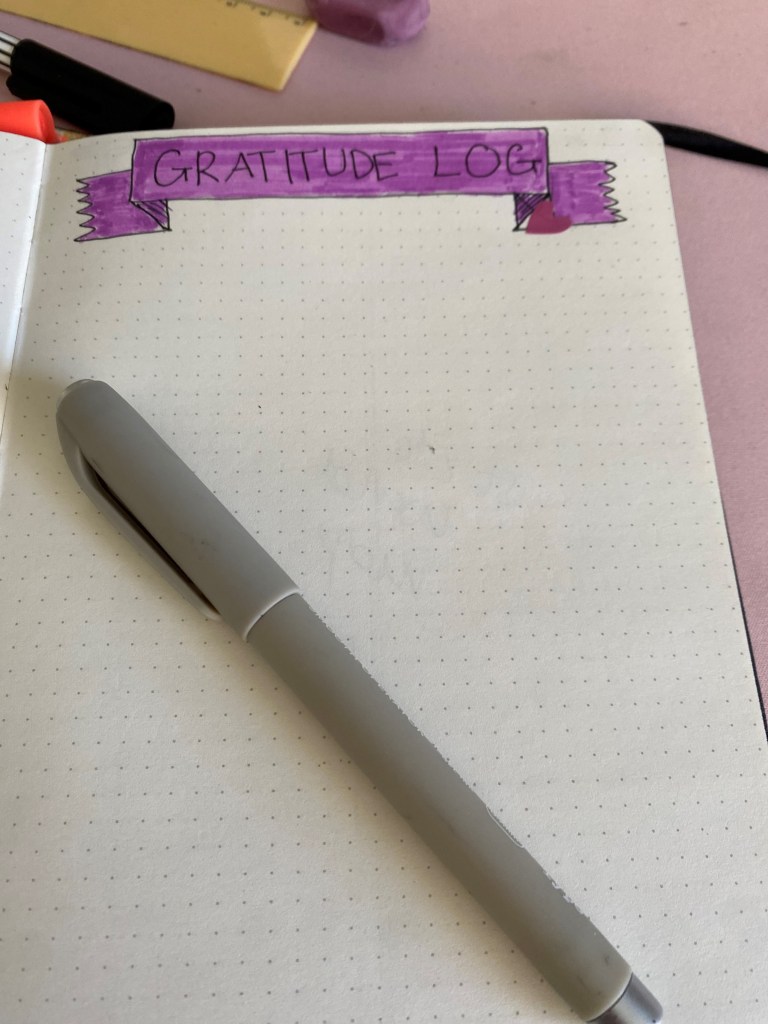
    As a person who struggles with clinical depression, remembering what I am grateful for in this life is helpful, having a list of things I’m grateful for that I can refer to when I’m really low is mental health first aid for me. My gratitude log (which is what I call it in my bullet journal) is a list of things in my life that I’m grateful for, but also reminders about me as a person and what I like about myself and that I’m grateful for.

    Gratitude is the best attitude, surrounded by leaves

    According to Psychology Today, the 7 scientifically proven benefits of gratitude are:

    Although I can see the surface level benefits for myself, I have wondered what is the psychology behind gratitude, is there any scientific benefit to it? Because it can feel really pointless, or fake, if you cannot see the value in it.

    1. Having gratitude helps build connection and relationships.

    Acknowledging someone’s contribution to your life, even if it’s something small, like holding a door open, makes an acquaintance desire to seek an ongoing relationship. So being thankful can help you make friends (it really is a magic word)

    • Gratitude improves physical health.

    Grateful people are less likely to experience health challenges and are more likely to take care of themselves (which is probably why they are less likely to experience health difficulties). That’s reason enough for me, I’m grateful that I am able to participate in sports like triathlon, because I don’t get bored, and it’s always a challenge for me.

    • Gratitude improves psychological health

    Being grateful can reduce the experience of emotions like envy, resentment and regret as it’s been known to reduce depression. It makes sense because if you are looking at your own life and what is great in your life, it’s very hard to be jealous of what others have because maybe they make more money, but they don’t have a family, for example. Also, it’s very hard to feel regret if you are grateful for the life you have experienced, instead of longing for a life you don’t have.

    • Gratitude enhances empathy and reduces aggression

    Grateful people are more likely to behave in a prosocial manner (also going to win you some friends). In the studies where they have measured gratitude, they found that grateful people are more likely to behave more kindly even when others aren’t showing the same type of behaviour. And I guess, if you start your day being thankful for life’s small mercies, it only matters what you do, and not how others choose to live?

    • Grateful people sleep better

    People who write in gratitude journal before bed have found to experience better and longer sleep. I may have to try this one out, because I sometimes forget what sleep feels like. I don’t know when last I woke up well-rested, so on some days, I need to end my day with gratitude.

    • Gratitude improves self-esteem

    Gratitude has been known to reduce social comparisons, which in tern, helps build self-esteem, because the focus goes from envying someone else’s life, to appreciating your own life, and being able to appreciate other people’s accomplishments, without feeling resentment.

    • Gratitude increases mental strength

    Grateful people have been found to be more resilient in the face of trauma. The basis of this is that being able to recognize what you have to be thankful in your life helps you to build resilience for those moments when you are struggling with a really challenging situation.

    The key message I have taken out of all the reading I have been doing on gratitude and self-love, is the renewed focus on yourself, and teaching yourself to appreciate who you are and what you have achieved, what you have in this life. It’s something small, you can do it when you wake up.

    I challenge you, for at least 30 days, to write down one thing that you are grateful for each day. Find those things in your life that will remind you why you should love yourself.

    Blank page, with header "Gratitude log" and pen lying on the page

    Resources:

    https://www.psychologytoday.com/za/blog/what-mentally-strong-people-dont-do/201504/7-scientifically-proven-benefits-gratitude

    Your words cut deeper than a knife

    Self-injury or self-harm, or cutting, is such a complex topic to discuss. It’s confusing if you don’t engage in it but you find out that your friends, or children, or loved ones engage in the act. Is it a suicide attempt? Is it attention seeking? Are they trying to follow some trend from social media? Why would anyone want to harm themselves?

    And the simple answer is that self-harm is a way of releasing overwhelming emotion or a way of feeling something in the absence of emotion.

    bandaged wrists, pulling sleeves down to hide

    What is self-harm?

    In moments of deep distress or emotional pain, some people engage in an act of self-injury. The type of act varies, and it can be cutting themselves, scratching at skin, burning skin, preventing an old injury from healing, hitting themselves against walls, pulling hair, getting into fights knowing they’ll get hurt, or any manner of causing harm to themselves. Any act, in fact that causes some sort of physical harm, it can even include the misuse of alcohol and drugs and unsafe sexual behaviour, or overeating and undereating.

    Self-injury isn’t in and of itself a mental illness, but it is usually a behaviour resulting from depression, anxiety, or trauma, which would need professional help. And because there is a lot of shame and guilt and embarrassment in the act of self-injury, the person might not be able to open up at all about the behaviour out of fear of judgement or angering or disappointing family and friends, but in fact they may need to so that they can get the help they need.

    Why do people self-harm?

    One of the most common reasons for engaging in self-injury is deal with difficult emotions like guilt, self-hatred or emptiness. Related to this, people engage in self-harm to express feelings that cannot be put into words or to release pain or tension.

    Sometimes, this is an act to feel something, anything, when the person is struggling with emotional numbness, or is feeling derealization (which is a feeling disconnected from the world), or feelings of dissociation (feeling disconnected from themself).

    Other reasons are for a person to distract themselves from challenging life circumstances, or to prevent themselves from doing something that is more damaging. It’s also a way for them to feel in control of out-of-control life circumstances. Another reason can be a way for people to punish themselves.

    Whatever the reason for a person wanting to harm themselves, we need to validate these feelings, and learn what is the reason for self-injury, and understand what is causing them to engage in this behaviour. Ultimately whether it is to feel control, to communicate emotion, to punish or to feel something, we need to help them feel seen, and understood. It’s important for them to have someone they can turn to because then next time, maybe they won’t need to engage in self-harm to release the pain, maybe they can speak to someone to address what is at the core of the need to hurt themselves, or to get professional help.

    There are a number of difficult experiences that can result in a person using self-injury to manage their emotional distress. For example, work or school pressures, bullying, low self-esteem, financial difficulties, abuse (physical, emotional, sexual), bereavement, homophobia or transphobia, relationship difficulties, loss of a job, stress etc.

    Myths debunked

    Myth: It’s attention-seeking

    Fact: While the area of self-injury may be visible to others, the act itself causes a lot of shame and embarrassment, so no it’s not attention-seeking. No one who engages in self-harm actually wants you to notice. That being said, what I have come to realise in my therapeutic journey, is that yes, maybe the person is “seeking attention”, but not in the negative connotated way we understand. When someone engages in self-harm, there is trauma there, or some kind of emotional distress, and maybe they don’t have the words to say I need help, and this act is all they can do to say, please see that I am hurting and in need of help.

    Myth: They want to kill themselves

    Fact: Usually the injury is too minor to actually cause any mortal harm, and the reason for self-injury is to release emotional pain, or address emotional numbing, or punishment, not a desire for suicide. Although that being said, it is important to note that this act is usually related to trauma, or depression, or anxiety, or other mental illneses, and the person could be experiencing serious emotional hurt that they may be suicidal, but the act of self-injury itself is not necessarily a suicide attempt.

    Myth: They are crazy or dangerous

    Fact: Not crazy, but yes, most likely suffering with a mental illness like depression or anxiety. Anyone engaging in self-injury is hurting more than anything, and struggling with life, or some kind of difficulty.

    Myth: The wounds are not bad therefore it’s not that bad

    Fact: Engaging in an act of purposefully hurting yourself is bad enough, whether or not that is a surface wound, or an injury that requires stitches. Most people who engage in self-injury will need to learn a healthier coping mechanism to deal with emotional overwhelm.

    wrist with win no scars, and wrist with lose with self-harm scars

    What to do if someone I know is self-harming

    Deal with your own emotions first – you need to acknowledge your feelings which might include anger or disgust before you address the act of self-harm. There is a lot of guilt and shame surrounding self-harm, and the emotions related to why the person would self-harm, so do not approach them if you are feeling anger or disgust

    Learn about the problem – it’s confusing and mysterious. So find out everything you can about self-harm before you speak to them. It will also help you deal with any feelings of discomfort if you have an understanding of self-injury

    Don’t judge – try and avoid any type of judgment or criticism. This type of reaction will only make the situation worse, and create more guilt and shame which will start the self-injury cycle all over again.

    Offer support, not ultimatums – If you want to help, be available as a person who is willing to listen to the persons’ problems, and who is willing to help them find solutions to their emotional distress. Express concern about what they are doing, but offer to help. And make sure that they know you are available whenever they need to talk. Self-harm can be a lonely and isolated road, and anyone would want to know that they have someone there for them

    Encourage communication – Encourage them to express their feelings, that you are offering a safe space for them to share how they are feeling, so that they do not have to use self-injury to release those emotions.

    Remember that self-harm is usually part of a larger condition, relating to the emotional distress, and it is a coping mechanism for extreme emotional distress, or feelings of emotional numbness. So, if you know someone who is engaging in self-injury, try and encourage them to seek professional help, and at the very least, offer them a safe space to talk about how the feel.

    They need to be seen, and heard, not judged and hated.

    Sources:

    Nami.org

    Mind.org

    Helpguide.org

    I found hope in a hopeless space

    No matter the circumstances, as long as we have hope, we can survive them. And that is the most difficult thing that I have found during 2020, is that I had no plans, no certainty, nothing to look forward to, and all I was left with were feelings of hopelessness.

    But coming into 2021, which is feeling a lot like 2020, the sequel, I needed a mind shift. I needed to find hope in hopeless situations. The pandemic is causing us to do some serious soul searching, it’s taking away the things that make us human, like our connections with other humans, our freedom to roam and explore our worlds.

    flower growing through crack  in concrete

    I have decided that this year, I will try and focus on the silver linings. One thing that the pandemic has given me is the blessing of family time. As a working mom, I very rarely spend a lot of time with my children outside of the weekend, but I was lucky enough to have time with them at home. We were able to do yoga routines, and artwork together, and jump on the trampoline. I have been grateful to be able to watch them grow up and learn, and change as the year wore on.

    I have also been granted more time to incorporate more reflective activities into my day. Last year, I started morning pages, which has been a great way to start my day, through journaling. It’s like clearing out my thoughts so that I can focus, and be mindful of the day ahead.

    Because of the isolation, and uncertainty of the pandemic, I have suffered quite badly with anxiety and depression, but the silver lining here is that I have more time to practice yoga, and spend more time in meditation, which I wouldn’t be able to do if I was working from the office. And I’ve managed to incorporate these activities into my day so that I do at least 5 minutes of yoga and 5 minutes of meditation every day, and these have aided in me being more mindful and remaining in the present.

    Person between barren land, and lush grass

    Activities that really help me out when I feel numb and withdrawn from the world are reading and writing. Writing, particularly, because it’s such a big part of who I am, and because I feel so passionately about writing, and because I feel energized once I have spent some time writing. I have had more time during my day because I am not commuting as much, I have been able to carve out time to write more.

    Because I do not need to wake up as early to get to gym, to get home in time for the school run to get to work in time, I have more time in the evenings, and have been able to spend more time reading. Admittedly, when my depression is really bad, I struggle with this, but my workaround for this is to either use audiobooks, or alternatively choose books that I am able to get lost in quite easily.

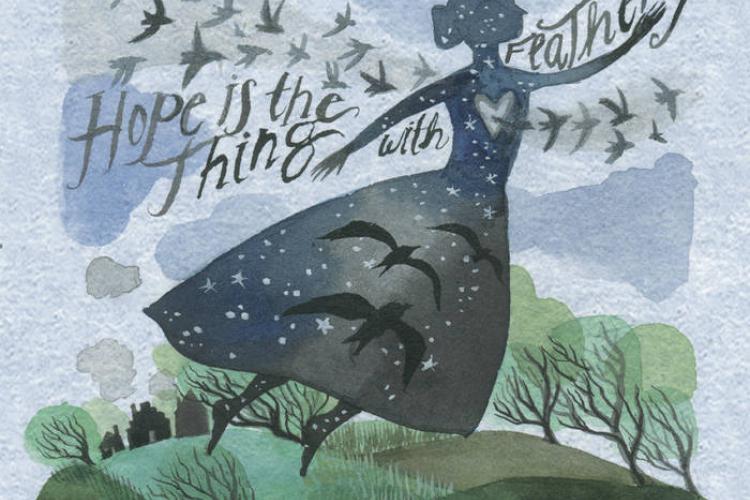
    Painting of "hope is the thing with feathers"

    This year, I want to spend more time on creative pursuits, like writing, and photography, and also to just be in the moment with my kids so more dance parties, and more playtime. And this year, instead of being so isolated, I want to reach out to my friends, because even when I do not feel like surrounding myself with people, I always feel better afterwards.

    No matter what you need to do to find your hope in what may seem like a hopeless situation, I encourage you to do it. it doesn’t have to be big. Some days, all it is is getting out of bed, or cooking a meal. Other days, it’s running 5km, or finishing the book you’re reading.

    Let’s refocus this year, and find our hope.

    "once you choose hope, anything's possible" Christopher Reeve

    The Magic of Christmas:

    I’m going to be honest. I have always loved Christmas. Looking back on my childhood, I remember the magic of Christmas. From attending Noddy parties, and getting my first gift of the year from Father Christmas, and the fairy whom we have to help turn on the lights once the Golliwogs have switched them off. And then the search for the Christmas tree, and then decorating it, including using cotton wool to make snow. And when I was a little older, being able to write letters to Father Christmas to ask for what I wanted. Christmas movies. It really was a magical time.

    The magic of Christmas and snowflakes

    But what I didn’t see was the challenging family dynamics that was underlying every Christmas lunch. My parents and aunts and uncles were all divorced, so it is a logistical nightmare to plan for the adults, because which year do the kids go to which parents. I very rarely saw my father’s side of the family, which looking back is a challenging dynamic in its own. His brother would also visit every year, and my ma refused to acknowledge his presence, a tension I felt then, but only understood once I was old enough. I rarely saw my sister for an extended period of time, which I only understand now was because she’s not a fan of Christmas, because of these difficult dynamics.

    And as an adult, once the magic was gone, it really was gone. I have some difficult Christmases that I look back on, some where I’ve spent the afternoon crying, or where I spent the day angry with something my father did. Or the year where I just felt really bad for my niece because she bore the brunt of the difficulties my brother and father were experiencing. Christmas is not magical. It takes all those family dynamics we avoid for most of the year, and then amplifies it on that one day in the year where we are forced to spend hours together and share a meal.

    Christmas is hard as an adult. We stress about having the perfect Christmas lunch, and buying the perfect gifts for everyone we love, and making sure we look good for that one day. The expense for that one day is astronomical, and doesn’t make sense, but we do it every year.

    Broken Christmas bauble

    Christmas is a trigger for many people. It’s a time of severe loneliness for many people, where they are reminded of how lonely they are. It’s a time when we also remember the people we are not seeing because they are no longer with us.

    But when we strip it all away, the real magic of Christmas lies in who we spend it with, and making sure that we spend our time with people who uplift us. And that we don’t feel obligated to see family that do not make us feel good about ourselves. We need to hold that boundary, and not allow an expectation of Christmas time being a family holiday, if our families only bring bad feelings. And acknowledge that it is ok to spend Christmas by yourself, and treat yourself to a special day. Eat a special meal, pamper yourself.

    However you spend Christmas and the festive season, whether it’s with others or by yourself, but make sure at the end of the day you are doing things that uplift you and make feel good. This year, the best gift you can give yourself is self-care.

    Look after yourself, and we’ll chat again in 2021.