Help me help you help me

I’ve shared a part of my story before, but in light of this year’s World Mental Health Day theme of mental health in the workplace, I thought I would share my workplace story. What I’ve learnt about mental health in the workplace is that you have to know your rights, fight for them, and for yourself, so that you are able to thrive because you deserve it.

A couple of years ago, I found myself in a situation where I was on maternity leave with my son, and we had found out that he had 2 holes in his heart, and then roughly 3 months after that I was retrenched. It was during all of these challenges, that I found my psychologist, and I went to her because you know, retrenchment and health of your children can stress a person out. (I mean, meanwhile, what was actually going on was decades of untreated trauma)

I eventually started a new job, and after a year of being in the job (and in therapy), I was struggling to stay on top of my work, because what I learnt about myself in therapy, was about how my other life difficulties were impacting my “at work” self, and making it hard for me to focus on succeeding at work (a residual effect of the retrenchment and child health stuff). Which tends to happen with mental health conditions – is that they are not isolated. It’s not like, “Cool, you will only be depressed, at home, on a Tuesday, Wednesday and Thursday”. No, it’s all the time, and in every sphere of life. So if you cannot get your homelife timetable together, because you are too depressed to care about anything, how would you get your work life timetable together?

My manager knew I was in treatment for Anxiety and Depression, and he was very understanding and gave me the flexibility to go to therapy during the day, and was very understanding when I needed time off.

Eventually, though, my lack of performance at work led to me being disciplined, and at the same time, my psychologist recommended that I be admitted to a clinic, because I was not mentally healthy, and needed some more serious, everyday mental health care.  

When I returned to work, my manager tried to take me off the performance improvement plan, because he figured that clearly not all is right in Whoville if I am being admitted. But the problem is. The business was not as understanding. His manager, who would be managing me, once he left the company, felt that my mental health issues and me not performing a work were unrelated. And the fact that I was now back at work, and no longer in a clinic meant that I was fit for work, so therefore, still had to “stand trial” for everything that happened during my depressive episode, prior to the clinic stay. Because you know, it’s isolated.

While at the clinic, I was diagnosed with ADHD, and that also explained my lack of meeting deadlines and challenges with prioritising etc, and I tried to sit with this new manager and explain to her, that I didn’t know I was fighting a battle last year, and now I know what I’m working with. And she was like cool, we’ll incorporate that into your performance improvement plan. Not, ooooh, I see, let’s take you off the PIP, and see if your performance improves and if not, then put you back on the PIP. In her mind, people underperform, and therefore, they have to suffer the consequences, regardless of the reasons for underperformance.

And that is the biggest challenge to employers, is to know that it’s not about ignoring failings, because yes, employees are paid to do their jobs. But what is required, is just a little bit of understanding. Because in my situation, all I needed was for a manager to go, let’s try and see how you do now that you have received some mental health help, and know that you have ADHD. And if I continued to underperform, I would have accepted the consequences, but I wasn’t given an opportunity to show my true potential, my true self, my accommodated self. I was rated against my struggling self, and forced to meet up to the standards of everyone who wasn’t struggling.

I managed to find help in the business through our mental health ambassador who helped me to have the right conversations with my managers about reasonable accommodations and to help them understand how my anxiety and depression showed up at work, and what supports I needed. And what I learnt from this experience was to always stand up for yourself and your rights, even when everyone around you is fighting against you.

Totes Traums

When you think of trauma, what do you think of? Do you think of moving house? Or do you think of death? Or war? Or do you think of growing up with a drug addicted parent? What about never being hugged as a child? 

One definition that I’ve read is that psychological trauma is a response to an event that a person finds stressful. That is why many people can experience the same event but only some of them are traumatised by the event and others manage to brush it off. Because like Gabor Mate says, “Trauma is not what happens to you. Trauma is what happens inside you as a result of what happens to you”. The experience is personal, it relates to what you are able to handle, and what you find stressful. That is why you shouldn’t feel shame that you are struggling to cope, but others who went through the same thing, or worse, are seemingly fine. Because psychological trauma relates to how you feel inside. 

So how do we respond to trauma? What does it look like? 

There are the relatively well-known responses, which include Fight, Flight, Freeze, or Fawn. Fight can be described as the person staying to fight the challenge, and this can look like aggression or bullying when it’s unhealthy, or assertiveness, or standing up for yourself when it is healthy. Flight is where the person responds by avoiding the conflict by leaving the situation, and this can be unhealthy if the person never actually deals with what is happening, by disassociating, but can be healthy where the person leaves a situation that is unhealthy, for example, in domestic violence situations. 

Additionally, trauma responses which are not as well-known are freeze, which is where the person is unable to act, they struggle to make decisions, or do anything. When this is unhealthy is when the person completely shuts down and does not engage in relationships, or refuses to act when they need to, however, this is healthy in situations where were the person to take on all the emotions of the situation, they would be overwhelmed because they are not ready to deal with what is happening. The fawn response is more known as people pleasing, because in response to conflict or challenge the person will do anything to appease other people. This is unhealthy when they forego their own needs or identity in favour of the other person, but it can be healthy where compassion and empathy are needed in the situation. 

So what can you do to manage your triggers or trauma? 

  1. Get your body moving – I’ve spoken about it before, but any form of body movement helps with managing  your mental health when you are struggling. It helps you get out of your head, but also helps you process the feelings within your body. 
  2. Try not to isolate, although it may be preferred. Talk to people that you trust, because it can help you process what you are feeling, and there are the benefits of social interaction that help to manage your mental health. Sometimes it is better to be with a group of people to ensure that the interaction is light if that’s what you need. Speak to a professional if you need to, and if you have access to one. 
  3. Self-regulate through mindfulness, or grounding, or sensory activities. Meditation can do wonders for managing troubling thoughts by focusing on being in the present moment and what you are experiencing right now. Grounding is a useful technique to use especially if you have been triggered and are experiencing a panic attack. 
  4. Look after your health. Eat healthily, get enough sleep, manage stress as best you can. 
  5. Find your safe space – it could be literal depending on where you experienced trauma, or it could be someone you trust, and who is supportive and understanding. 
  6. Feel your emotions. This is not always something that we want to do – it’s uncomfortable, and unpleasant, but it’s so important for healing. Allow yourself to feel what you are feeling, sense where you experience it in your body, and through that you can help yourself heal. You don’t have to fully integrate the why, just know the what and the where. You can address the why when you are ready, and when you have help. 
  7. Get to know your triggers. If you can, you can manage these by avoiding them, but what is important is to know what they are so that if you aren’t able to avoid them, then use techniques like breathing meditations, grounding, use sensory items. 
  8. Give yourself time. Healing trauma isn’t an immediate thing, it will take time to work through your emotions, and to process the experience, and it will take a lot of work and time to ease the impact of the trauma. So don’t judge yourself if it’s been years and you’re still not “over it”. It’s ok, the impact of trauma can be visceral and not easily or quickly dealt with. 
  9. Find ways to relax – what are the things that you enjoy? Being in nature, dancing, watching light-hearted TV, reading, writing, colouring. Anything that can put your mind, and body, at ease. 
  10. Build a routine. Consistency is what you need to feel like yourself again. Maybe the routine is different from the one you had before, but it’s important that you have that certainty about what will happen daily, and that you have something to focus on. 

Have self-compassion if you are working through a trauma – it’s ok to take a long time, to struggle with the impact of the trauma. Focus on the small steps, or just the impact on your body as a start. Little things each day. 

Resources:

https://www.mind.org.uk/information-support/types-of-mental-health-problems/trauma/coping-with-trauma/

I saw the signs… and it opened up my eyes

Since being diagnosed with anxiety and depression, I have become aware of the symptoms… at least I thought I was. I’m very much still on my healing journey, and sometimes, need someone outside of myself to tell me that my “check engine” light is on. 

Things were happening in my life, that irritated me, and made me sad, and annoyed. But I thought that it was just that. A normal reaction to life sucking. A side effect of adulting. 

Until my psychologist told me to make a call to my psychiatrist. And it switched on a light for me, highlighting to me that my “check engine” light was on… and flashing aggressively. And I was ignoring it, and continuing to drive far into the distance without stopping. My psychologist had to point it out to me that I am not ok. 

And then I started looking around. I was exercising, sure, but begrudgingly, and where I could cancel, I did. My eating was well, indulgent, to say the least. I was not reading (beep! beep! beep!), I was not writing. And worst of all, I spent all of my time at work complaining, not laughing (I mean, working) at work. I didn’t see it. I was depressed. More depressed than I had been in a very long time. 

When I finally saw the signs, I could do something about it. 

Thankfully, it coincided with a meditation course I was on. Meditation is one of those things that can really help. I didn’t realise how much, but once I became aware of my feelings, I could become aware of what they were doing in my body. And that is why mindfulness is so helpful for mental health, and how meditation can help to relieve some of those difficult emotions. 

Once I realised I had been mindlessly eating, I made a concerted effort to be mindful about my eating. I don’t always make the right choices, but at the very least I am making conscious choices. And that is important for me. Because you can only change something that you are aware of. 

I also had to watch uplifting content, and for a while I refused to allow myself to watch anything but comedies, but then I realised that my crime series was strangely uplifting because there was a resolution, and I enjoyed the problem-solving. Sometimes what is uplifting is strangely un-uplifting from the outside, but nevertheless, it’s whatever makes you happy. 

I made sure that I switched off all devices an hour before bedtime, to ensure I got a good night’s rest, which opened up an entire extra hour in my day for me to read. Which, in a virtuous circle, helped me to fall asleep faster too. (also, I put down the sad stories about people going through what I’m going through, and read inspiring stories, self-help books, and books about finding meaning). 

I also allowed myself to lean on others, and let them help and support me (a biggie). I didn’t have to do this all on my own. There was no shame in how I was feeling, and I had friends and family who were willing to listen to me and be there for me, whenever. (thanks, by the way)

And then there was writing – this blog, in fact. I spent some time researching the concept of self-worth, and it was a turning point for me. It made me realise that I was putting my worth into the wrong things, and giving away my power to issues and people who really didn’t deserve the power of the mind I was giving them. I have a lot to learn about self-worth, and a long way to go before I truly realise my self-worth, but the car is in the shop, while I continue on this journey (ok, this analogy isn’t really working out, but you get the idea). 

Why am I never good enough?

My psychologist and I were talking one day, about negative feedback that I had received. And her response to me was, “But what if you weren’t good at it?” And I was left speechless… 

Because that was the reasoning for the question, do I need to be good at everything, and beat myself up when I’m not. Do I need to be good at contemporary dance? No, but it doesn’t stop me from doing it. Do I need to be the best writer there ever was? No, and it shouldn’t stop me from writing. 

Because at the heart of feelings of inadequacy and not being good enough, for things that are not inherent to who we are, is a lack of self-worth. And it is something I personally need to interrogate with myself. Because it’s not isolated to education, or work, or motherhood, or hobbies, or friendship – it permeates every interaction, every thought, every role that I play. 

So what is self-worth? And how do we get it? 

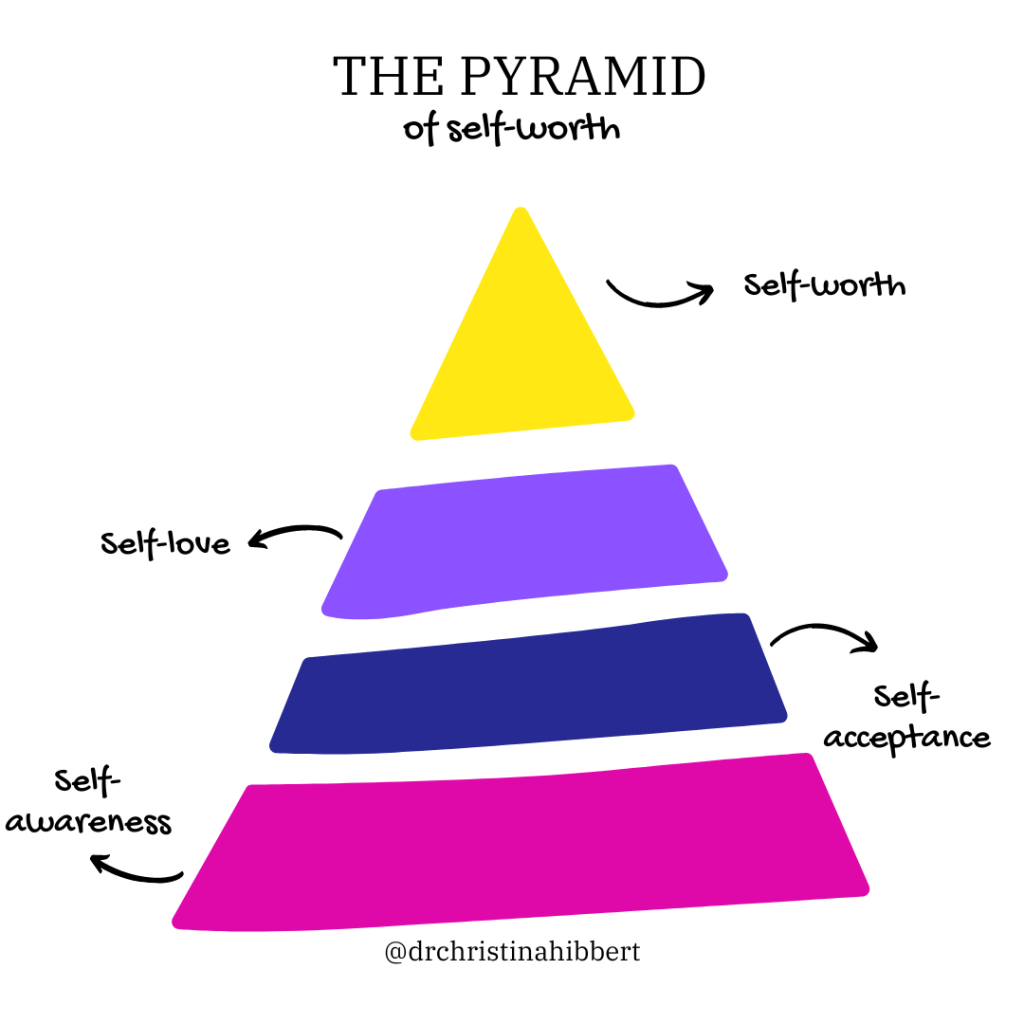
I have been focused on self-knowledge, self-acceptance, self-love and self-care, and while all these are important, I need to be aware of the importance of self-worth. Lest I attach my worth to something fleeting. To be honest, I’m very much in the “packing” stage of my self-worth journey, but I’ve learnt so much, that I just want to tell people about its importance. 

I read a very interesting article by Dr Caroline Hibbert, and she speaks about the pyramid of self-worth. It starts with self-awareness, meaning you need to know who you are, what you are made of, what your values are, what comprises your identity, your strengths and weaknesses – who you are. It involves getting to know yourself. 

Once you know what the parts that make up who you are, you need to accept them. You may not like who you are or your different parts, or even what you have identified as your strengths and weaknesses, but it’s important to accept that this is who you are. It can be difficult to acknowledge what your strengths are, or to be able to accept your weaknesses, but they are who you are right now. 

And then, a crucial part, is to learn to love yourself for who you are, flaws and all. Self-love includes self-care, self-compassion, being kind to yourself, treating yourself well and taking care of your needs. Give yourself permission to give love and accept love from others. 

Self-worth then, as defined by the American Psychological Association, is evaluating yourself as a capable, valuable human who deserves respect and consideration. 

When we have low self-worth, we don’t have much trust in our abilities, we become fearful of failure, and then as a result, we are unable to accept positive feedback and become overly focussed on our weaknesses. Additionally, because we believe we are unworthy, we perceive others as having more value than us, and then we allow them to infringe on our boundaries, we minimise our needs or become people pleasers who are unwilling to stand up for ourselves. 

On the contrary, if we have high self-worth, we tend to believe that we will be all right, no matter what happens and we have the confidence that we will be able to manage whatever life throws at us. What we know about ourselves because we have self-awareness about our weaknesses, we are confident that we can improve them. 

So what can we do to improve our self-worth? 

Remind yourself what does not encompass self-worth like your job, your salary, your grades, social media likes etc

Work with and challenge your inner voice so that it is not always critical and reinforcing that you are not worthy

Do things that you enjoy and are good at

Exercise and do things that challenge you because it provides you with evidence that you are capable of achieving things that you may have previously not thought possible. 

Seek support, if you have access to a psychologist they can help you through what is hindering your self-worth, and you can determine strategies to improve it. 

Resources used in this post:

https://dictionary.apa.org/self-worth

https://www.verywellmind.com/what-is-self-worth-6543764

https://positivepsychology.com/self-worth/

I’m not who you think I am

My Imposter Syndrome is so bad, that I didn’t even think I was good enough to have a mental health condition.

I remember the first time I met my psychologist, and she asked why I was there, and I told her, “You know… Champagne problems”. Despite, in the same year, getting retrenched while on maternity leave, having a pregnancy where my son was at risk of heart failure, then being born with a hole in his heart. Those really are not Champagne problems. But I didn’t think I deserved to have mental illness. 

And then when she took my history and I revealed my parent’s divorce, my mother’s miscarriages, growing up with a father in a different city, being born during Apartheid, losing my grandfather whom I was close to, changing schools at age 9, and going to a school that was formerly a Model C and being one of very few girls of colour, having a minor operation including going under general anaesthetic, and that was just ages 3-9. So these are not Champagne problems – these give me a score of 8/10 on the ACE test (that measures trauma).

What I later realised was that I went to therapy because I had serious self-love challenges, and we worked on getting me to not think of myself as an unlovable screw up for the first few months. And when we spoke about relationships and friendships, she would also tell me that I have these great characteristics, that would make a great friend. And I remember a year in, saying to her, “Do you get why I’m an unlovable screw-up yet?” No, she didn’t. And that is what Imposter Syndrome does. 

It makes you believe that you are not as amazing, as you actually are. 

Imposter syndrome is defined as having self-doubt of your intelligence, skills and abilities, and achievements. Even if you have achieved things in the past, if you are struggling with imposter syndrome, you are unable to internalise those achievements as an indication of your abilities. So what happens is that you believe that even if other people believe that you are a success right now, eventually they will realise that you are actually a fraud and not as great as they previously believed.

Imposter syndrome holds you back from the self-confidence that you deserve, based on all the efforts you have put in to achieve what you have achieved, no matter how big or small these goals or achievements are. 

Recognising imposter syndrome in yourself (Verywellmind.com): 

  • Being unable to realistically view your skills
  • Attributing all your success to external factors
  • Always feeling as though your performance was not good enough
  • Fearing that you cannot live up to expectations
  • Being an overachiever
  • Being a self-sabotager
  • Having self-doubt (especially if those around you wonder why)
  • Setting very challenging goals and feeling like a failure when you are unable to achieve them

So what do you do, if you think that you have Imposter Syndrome? You need to acknowledge that the reason you are experiencing self-doubt relates back to your feelings of self-worth and your core beliefs about yourself. What narratives are you telling yourself about who you are? 

Here are some tips for combating your imposter syndrome:

  • Listen to the voice that is telling you that you are not good enough – you need to be aware of when it is speaking up. (you don’t have to believe it, you just have to acknowledge it’s there)
  • Realistically consider the evidence for your self-doubt. One suggestion is to write down evidence that you are inadequate in one column, and in the other column, evidence that you are competent. 
  • Review your values, because Imposter Syndrome is focused on achievement orientation, which is great as long as it’s not impacting you negatively – and self-doubt is a reason to relook your values, and focus on things that are not overly achievement focused
  • Consider your definition of growth and what it means to you – if your perfectionism as a result of imposter syndrome is stopping you from improving, or growing or changing because you are afraid of making a mistake, it’s time to reframe what that means to you. Are you growing? 
  • Get out of your head – write down all the thoughts about your perceived failures, or chat through them with a friend, or professional. It can help to to get a different perspective. 
  • Have self-compassion for yourself, and that voice in your head. It’s been through a lot to have to protect itself with self-doubt. Try not to beat yourself up for feeling like a fake. You know why you doubt yourself now, so now you can work on it, and give yourself credit for working on yourself.
  • Know that failure is a part of life. Reframe how you feel about failure, there is no learning if there is no failing, and considering personal growth from this perspective can help you accept failure as part of the effort, instead of fearing it. 
  • Mindfulness helps you to be in the present moment, to acknowledge your thoughts, consider why you think them, and to accept the feelings around the thoughts. Spending some time in meditation each day helps us become aware of ourselves and feelings and helps us be in the moment instead of being overly focused on the future or obsessing about the past. 
  • Get feedback from people in your support network – people whose opinions you can trust, and know that they want what is best for you. 

At the end of the day, know that you have value, and that when we measure our value against external things that could change, it tends to lead to more moments of self-doubt. We need to learn to accept ourselves for who we are and acknowledge that we have value, regardless of what is valued by society and the world around us. 

Resources used in this post:

https://www.betterup.com/blog/what-is-imposter-syndrome-and-how-to-avoid-it

https://www.verywellmind.com/imposter-syndrome-and-social-anxiety-disorder-4156469

“I don’t know how she does it” (because who else will?)

I remember when I was pregnant with my daughter, and attending ante-natal classes, and they spoke about the difference between the baby blues and post partum depression. I didn’t realise then that baby blues was a thing, I mean I’d heard about post-partum depression because of my interest in psychology and mental health, but this baby blues thing was new. And then I went about my business of being super excited about becoming a mom. Because I had a relatively easy pregnancy (humble brag), and you know, I’d read all the stuff, and I had a support system of women who’d done it all before, and were giving me great advice about pregnancy and giving birth and hospital stays, and the changes in your marriage. 

But still, despite all that, I ended up having a bout of baby blues where I was sitting there at 10pm, after feeding my daughter, and she had fallen asleep, and then I cried. And cried. And cried. Because I was overwhelmed, and I felt alone, and I didn’t know if what I was doing was right, how could I be a good mother, I’m tired, and alone, and confused. 

But we never speak about the waves of “baby blues” that happen later on in motherhood. The overwhelm. The crises. The feelings of loving and hating being a mother at the same time. The worry about whether or not you’ve made the right decision. Did you handle that situation correctly? Are you raising jerks? Are you raising pushovers? Are they in the right school? Are they doing too many extra murals? How did that time you screamed at them last week affect the rest of their lives? And was the screaming justified seeing as you asked them 5 times and they still didn’t listen? Are you a bad mother? Are you a good mother? Is your mothering mediocre? Does it matter? 

For some reason, all people think that they are experts in motherhood, even if they have never been a mother. Is it because you have a mother? Because I have a car, but I am no mechanic. And even the criticism we get from other mothers, they also don’t know what you are going through. Maybe they get what it’s like to drive a Mercedes Benz but what do they know about your 1995 Opel Kadette, with its unique challenges. 

We hear so much criticism from so many places, and so much judgment, and we actually just need to support each other. Because motherhood doesn’t come with a manual. So we learn as we go. And sometimes we make mistakes.But it’s hard. It’s overwhelming. 

And because it’s so challenging, we need to remember ourselves. We need to do things for ourselves. I read something online recently which said that fathers’ activities traditionally take them out of the house, so they are not available to their family for an hour or more, and they can truly have that time to themselves to unwind. Mothers’ activities have traditionally been things you can do while looking after kids. So I challenge you to take it out of the house, so that you can truly be by yourself. To reboot. And grocery shopping does not count. 

What is it that brings you back to you? Who were you before you were a mom? What defines you as you, outside of motherhood? Do that. Even if it’s something you have tried at home, like reading, and you keep getting interrupted, take it out of the house. Go sit in a coffee shop with a book, or out in nature. 

Give yourself time for you. 

Maternal mental health is not only about preventing illness like burnout, or depression. It’s about making sure that you are mentally healthy in general, so that you are able to be in the moment with your children, that you are able to co-regulate and connect with them.

Some things that I have done to help with my mental health, and to reconnect with myself have been to refocus on making myself both physically and mentally healthy. I gave myself the goal of completing a sprint triathlon, which I eventually completed in 2023, and I felt this sense of achievement, and more connected to myself because before becoming a mom, being a triathlete was a large part of my identity. Best part was swimming for an hour a week at least, because nothing brings me more calm than swimming endless laps in the quiet of the water. 

For a while now, my weight has been a bit problematic, and I sometimes lose weight, but I gain it all over again, and I have started seeing a dietician who has helped me assess why I’m eating, and given me key strategies to help me to eat healthily, it’s not restrictive, but it has made all my meals healthy. And being a little bit more healthy than I was yesterday has helped with my mood, and energy immensely. 

Most recently, I have started mediation workshops with Tessa Nel whom I met a few years ago for a group called Mindful Mamas. She is teaching us about meditation, and a big part of why I have signed up is for the self care for myself. To learn how to be mindful, to find those moments in my day to be present, to start being aware of my body. In my first workshop with her, in the opening meditation, I immediately felt that I had been clenching my jaw, and I was able to release it, then I felt the tension in my shoulder and I could release it, while focusing on my breath. Had I been tense all morning? She is helping us learn to be self-aware, and then also to have self-compassion.

With that in mind, be aware of your own needs, and give yourself some self care – you need it. And more importantly, you deserve it.  

I’ve included some resources below, because sometimes what you are experiencing is more than “the baby blues”, or everyday motherhood, and if you are, please speak to someone. 

Resources on maternal mental health:

African Alliance for Maternal Mental Health – https://aammh.org/

Maternal Mental Health Alliance – https://maternalmentalhealthalliance.org/about-maternal-mental-health/

South African Depression and Anxiety Group – https://www.sadag.org/

It’s never to late to begin again

Sometime in last year, I had somewhat of an epiphany, and while working through it with my psychologist, I lamented how far down the “wrong track” I was, overly focused on how old I am. And my stage of life. All she said to me was, “You’re never too old to go down the right path”.

Age is a social construct.

You are as young as you feel.

Age ain’t nothing but a number.

These may be platitudes, but if we don’t want to live with regrets, we cannot continue to live with the belief that life ends at 25. You’re not Leonardo Dicaprio. There is a whole lot of growth and self-awareness that can only happen after 25. Our frontal lobe is only fully developed at 25. So life doesn’t end at 30 or 40, it just changes. Just like it changed when you turned 5, or 13, or 18, we cannot stop ageing. But if we don’t want regrets when we’re older, we cannot let ageing stop us.

Starting to run again a few years ago

Allow yourself to be who you are. Respect the fact that having 30 years of knowledge of yourself gives you a wisdom that you didn’t have at 18. So if you want to change careers, study again, start a sport, do ballet… why not?

Why spend more time going down the wrong path? No matter how far you are down the wrong path, you can always turn back. I read that quote when I was in High School, and I’ve tried to always live by it. For me, realising I’ve gone in the wrong direction, means that I have new knowledge, that I cannot ignore. Do I want to spend the rest of time going down the wrong path? Or do I want to turn around, and actually go down the right path? And spend the rest of time there? Isn’t that preferable?

My psychologist reminded me that I could live my life with regret that I didn’t make a change that was deeply needed, and I could continue to believe that I was too old to live the life of my dreams. Or… I could change paths.

Imagine you were driving along a road, to a friend’s birthday party, and when you’d been driving for 30 minutes you realised that you were going in the wrong direction. Would you continue along that path because hey, you’d been driving for 30 minutes, and now you would waste 30 minutes to go back and change directions? I’m sure any one of us would go back and change directions because you are not going the way of your destination.

Our lives are no different.

You can always start over. And even if that relates to something like a depressive episode, or difficult period of life. That’s why it’s called an episode – it’s not the whole series. It’s a period of life, meaning there could be a new period on its way.

Right now, what you are going through could feel like it’s never ending. But we have the ability to start over. To make it end. To start something new.

And even in the moments where we feel like we are trapped, and we are unable to live the life we want, for whatever reason, know that you are empowered to make that change. Sometimes it’s small, like choosing to consume uplifting content and not comparing yourself to social media lives. It could be something big like quitting your soul-sucking job.

Most importantly, we need to believe that we are empowered to do these things. Especially in the moments when we feel like we are not.

Only you are holding yourself back from starting over. Starting to be content. Starting a new job. Starting therapy. Starting a new hobby. Starting to study. Starting to be a you that is grateful and brave.

You do you Boo

If you had met me about 10 years ago, part of my self-description would include triathlete. On a whim in 2011, I decided to do a triathlon, and managed to achieve the goal with the support of my sister-coach, my fellow tri-lady and family and friends. I enjoy the sport so much because it appeals to my (then undiagnosed) ADHD mind which just cannot stick to one sport.

Completing my first triathlon

I managed to complete a few triathlons, and then I fell pregnant for the first time. Throughout my pregnancy though, I tried to upkeep the swim bike run training, which eventually became swim walk training, because being a triathlete was so entrenched in who I am.

And then I just stopped. And all I did was mother, and worked, and occasionally saw my friends.

And then fell pregnant again… having to mother more, and after being retrenched, finding a job and feeling the need to work harder so that it doesn’t happen again.

And I didn’t pick up triathlon again. Does that mean I’m not a triathlete? Is it no longer a part of my identity?

And I spent the next few years trying to figure out who I am, and learning to love myself. The moment I stopped doing things like triathlon is the moment I told myself that who I am mattered less than who others need me to be.

Completing Sanlam mile swim in 2019 – getting back to myself slowly

It’s been a struggle to get back there, to put myself first. My children grew up into tiny humans with their own stuff, and they needed me to be there, and I wanted to be a part of their sports and activities.

What I realised last year was that being their mom didn’t have to stop me from being Leila: the writer, triathlete, blogger, lover of coffee and cupcakes.

And so began my journey back to myself.

Completing my first 10km since becoming a mom

I set myself the goal of completing a triathlon, I found an accountability partner and a training plan, and set off to achieve that goal.

And on the 5th of November 2023, I completed it.

Achieving my goal at Tinman triseries

I feel like I have returned to myself. It is in that moment of accomplishment that I felt like Leila again. I did something for myself. For my own reasons.

And I think that’s the important lesson for me in this. That we need to have self-integrity. That we know ourselves, and in our journey to loving ourselves, we stay true to who we are, we do what is important to us. Most importantly, we do what we say we are going to do.

“I will do a triathlon.”

And I did.

Part of your self-love journey needs to include being true to yourself, and having that self-integrity to do what you say you are going to do.

It took me 9 years to learn that and stick to it, but I did it.

And I encourage you to do the same, whatever that thing is that makes you you. Make sure that you carve out time for it, even in the chaos of life. 

Is Hustle culture worth it?

When I was born, my mother was forced to stop working for a year because she gave birth. It was quite hard time for women to be working, they were allowed to work, but there were still subject to sexism if they gave birth, they were unlikely to be promoted, and company boards were all male.

So, as women, we had to work twice as hard as men to be seen as half as good. It’s ingrained in me to work hard, because at some point I’m going to give birth, be moody during PMS, cry because I’m angry, wear an outfit that is sexualised by colleagues, so my work has to work that much harder to have value.

And yes, the world has changed quite a lot since my mother quit working to give birth, and yes sexism is not as prevalent, and sure there are companies led by women, but still, all of us believe in hustle culture.

We always have to be working hard. Once you’re done working on your day job, what is your side hustle? Work work work work work (Rihanna said it best). And if you don’t, you won’t succeed, you won’t afford the life you want, or be able to keep up with the school moms (formerly called the Joneses).

But is it healthy?

Not only have we seen an increase in non-communicable diseases since the advent of hustle culture, but we’ve seen an exponential increase in stress-related illnesses, both physical and mental. But for all us millennials out there (especially the elder millennials), we cannot shake this. We have to work hard always. We will even work when we’re on sick leave. We’ll send emails from our kids sports’ matches.

And even for those of you out there who don’t take your day job as seriously, no doubt you have some side hustle that you are trying to get going so that you can quit that day job that you don’t take so seriously. So you aren’t actually resting (even if you aren’t a work nerd like us).

True rest is doing things that don’t require your brain to work in overdrive (dictionary definition of hustle).

If you’ve trained for a race, you will know that in your last week before your race, you have to taper your training, rest your body to allow it to recover so that it has optimal energy to perform in your race. And it’s the same for life.

You have to spend some time slowing down, smelling the roses, enjoying life for fun’s sake. YOLO is not about living a chaotic life that moves from moment to moment, always being busy, or engaging in risky behaviour.

Knowing that you only have one life to live should be about making sure you live it right, that you are able to enjoy it. So give yourself moments of calm, time for reflection, meditation, enjoyment.

It’s ok to not always be hustling.

We need to make time for mental, and physical recovery. And slowing down doesn’t mean poor performance, it means, conserving energy and building up stores for optimal performance later on.

Rest and recovery and not hustling hard er’ry day doesn’t mean underperforming, it means giving your body time to heal, and recover to be able to do better tomorrow. So that you can perform at your best.

Our bodies need nutritious eating, water, sufficient sleep, to operate optimally, and this improves your mental health too. Part of that should be making time for things like meditation, and spending time outdoors in nature, getting enough sunshine, connecting with others, and just doing things you enjoy.

What are you going to do to give your mind and body the rest it needs?

Mental health conditions are more than Anxiety and Depression

While depression is statistically the most common mental health conditions that people around the world have experience with, and when we talk to mental health, there is an underlying understanding that yes, we are referring to depression, or anxiety. A lot of celebrities are talking about their struggles with depression, or suicidality. There is a lot of awareness and information on social media and the internet around depression and anxiety to the point that these are synonymous with “mental wellness”.

But they are not the only ones.

Bipolar Disorder

Bipolar is characterised as having alternating experiences of depressive episodes with periods of manic episodes. There are different types of Bipolar depending on whether the person experiences a manic episode or hypomania and a depressive episode. During a depressive episode, the person will experience feelings of sadness and hopelessness, fatigue, memory loss, changes in appetite or difficulty concentrating. An episode of mania or hypomania, by contrast, is characterised by excessive talking, racing thoughts, hostility, little sleep, overconfidence in abilities and risky behaviour, including excessive spending and risky sexual behaviour.

Bipolar does need to be diagnosed by a medical professional, and there is no cure, but it can be managed with medication. It can be quite a difficult experience for the person experiencing these episodes for the first time, and it can be very confusing.

Schizophrenia

Commonly misunderstood as a person who has “multiple personalities”, and colloquially, people refer to poor decision-making as “being schizophrenic” as a result of this.

What Schizophrenia is actually characterised as, is a person has thoughts and experiences that seem out of touch with reality, coupled with disorganised speech, thoughts or behaviour and then also the person starts to show a disinterest in day-to-day life. Other symptoms and signs can include feelings of paranoia, suspicion or fear, unusually slow movements or speech, emotionless facial expressions or speech and isolating behaviours.

This is one of those mental health conditions that needs to be diagnosed and managed with a healthcare professional. There is a high risk of suicide with this group, and a high percentage of homelessness and drug abuse amongst people who struggle with Schizophrenia. It can be very challenging to manage, and while I don’t know many people who are able to live full lives with Schizophrenia, I do know that it is possible.

Obsessive-compulsive Disorder (OCD)

Another mental health condition that gets a bad rap in the media, and everyone who thinks that they are incredibly neat and organised refer to themselves as “OCD”, meanwhile the actual condition is actually quite difficult to live with and is not a cute minimalist way of living.

To actually be diagnosed with OCD, a person needs to struggle with intrusive thoughts which are defined as obsessions, and these thoughts need to lead repetitive behaviours, which are the compulsions. The person feels that they need to perform these behaviours and if not, then something bad will happen – which is part of the intrusive thoughts.

Also something that needs to be diagnosed and managed with a healthcare professional to be able to live a full life, despite these intrusive thoughts.

Post-traumatic stress disorder (PTSD)

There is a misconception that only soldiers experience PTSD, however, any experience of trauma can result in PTSD. Secondly, the definition of trauma is a lot broader than we typically understand. Trauma can be a family home where parents fight a lot, lack of emotional connection with family, moving house, surgery, racism etc. While not a formally a DSM-V diagnosis, complex PTSD is a consistent experience of emotional neglect and other similar experiences and the symptoms are the same as PTSD as a result of a singular traumatic event.

Dissociative identity disorder (DID)

Not only has this been misdiagnosed amongst society as Schizophrenia, but also there have been many movies that have demonised people who struggle with DID. In all these Hollywood imaginings of DID, there is always a serial killer hiding in the mind of a mild mannered man, who is responsible for killing or kidnapping innocent victims. But in reality, any person who needs to dissociate has very real trauma that they need to protect themselves from experiencing, which is the basis of DID. When a person experiences a severe trauma, that they cannot emotionally manage without falling apart completely, so they develop different identities to hide behind, to avoid experiencing trauma in its entirety. It’s a protective mechanism, not a mode of taking out a violent tendencies on the world.

Autism

A couple of years ago, I was reading that infamous article which tried to convince people to not vaccinate their children, because vaccinations cause Autism… but you know what’s worse than Autism? Death. The fact that this article managed to scare people into not vaccinating showed the poor understanding that the world had of people who have Autism.

Autism is characterised by differences in how the brain is structured, which shows up in differences in socialisation and interactions with other people and the world at large. They can still have a quality of life if they receive societal understanding, educational and employment support.

If Autism is diagnosed early, the child can receive the right supports that they need to live a full life. Parenting is significantly more difficult, but as society at large we need to understand that Autism is a form of neurodivergence and learn to appreciate that anyone with Autism just has a different way of viewing and interacting with the world.

Overall, when we speak about mental health, and mental health conditions, we need to remember that there are people who are experiencing different types of struggles, and to learn to be supportive and non-judgemental. Even if someone is struggling with something other than depression and anxiety.